
When ESE Protection Makes More Practical Sense
For factories, commercial buildings and industrial sites, lightning safety is not just a technical choice. It affects people, equipment, electrical panels and long-term property safety. Many buyers compare ESE Lightning Arrester vs Conventional Lightning Protection System before finalizing a solution. However, both systems work differently and suit different project needs.
In Ahmedabad, Gujarat and across India, buildings face seasonal lightning risks, especially during heavy monsoon conditions. Therefore, factory owners, contractors and safety consultants should understand the difference before installation. A proper system must include air terminals, down conductors, quality earthing and regular testing.
How Both Systems Handle Lightning Risk
A lightning protection system gives lightning current a safe path to the ground. It does not stop lightning. Instead, it reduces damage by guiding the current away from unsafe paths.
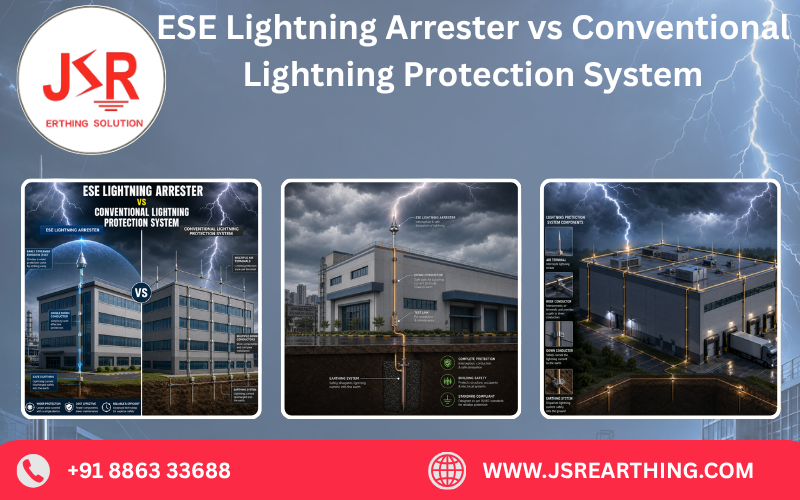
An ESE lightning arrester uses an Early Streamer Emission terminal. It is designed to create an upward leader earlier than a normal terminal. Because of this, it can cover a wider protection area when designed correctly.
On the other hand, a conventional lightning protection system uses multiple air terminals, conductors and earthing points. It protects the structure through a planned network over the building.
ESE System: Where It Works Better
ESE systems are often preferred where a wider protection radius is needed with fewer visible points. For example, they can work well for factories, warehouses, commercial buildings, schools, hospitals, towers and open industrial areas.
Moreover, many project owners choose ESE when the structure has limited roof space. It can also reduce the need for too many air terminals on some buildings. However, correct height, placement and earthing are very important.
Most importantly, an ESE lightning arrester must not be installed like a simple pole. The complete system needs proper down conductors and low-resistance earthing. Without these parts, performance can reduce.
Conventional System: Strong Network-Based Protection
A conventional lightning protection system is suitable for buildings that need distributed protection. It uses several air terminals across the roof area. These terminals connect to down conductors and earth pits.
In many cases, this system works well for large roofs, complex building shapes, industrial sheds and structures with sensitive electrical areas. It also gives designers more control over protection zones.
At the same time, conventional systems may need more material and installation planning. Therefore, project layout, building height and risk level should be checked before choosing it.
ESE Lightning Arrester vs Conventional Lightning Protection System: Practical Comparison
The main difference is the protection approach. ESE works with a special terminal and planned radius. Conventional systems work through a network of terminals.
For smaller or medium structures with open surroundings, ESE can be a practical choice. For wide roofs, complicated structures or projects requiring multiple protection points, a conventional system may suit better.
However, no system should be selected only by price. Buyers should check design calculation, material quality, down conductor route, earthing resistance and testing support. As a result, the system becomes safer and more reliable in real working conditions.
Key Installation Points Customers Should Check
Before installing a lightning arrester for building safety, ask for a proper site study. The installer should check building height, roof layout, nearby structures, electrical load and existing earthing condition.
In addition, the down conductor path should be short and safe. Sharp bends should be avoided because lightning current needs a smooth discharge path. The earthing pit must also match the site condition.
For industrial lightning protection, the system should protect control panels, machinery, storage areas and high-risk zones. Because of this, factories need expert guidance before final selection.
Local Safety Needs in Ahmedabad and Gujarat
Ahmedabad has many industrial estates, commercial complexes, warehouses and high-rise buildings. Many sites also have rooftop solar plants, DG sets, panels and communication equipment. These assets can face damage during lightning events.
Therefore, a properly designed lightning protection system in Ahmedabad should consider local building style, soil condition and maintenance access. In Gujarat’s industrial areas, dust, heat and moisture can also affect metal parts over time.
For this reason, periodic inspection matters. Loose clamps, corroded joints or poor earthing can reduce system performance. A safety system should be checked before and after the monsoon season.
Material, Testing and Maintenance Matter
Good design starts with good material. Copper bonded, GI, copper or suitable approved materials should be selected based on site needs and budget. Moreover, all joints, clamps and conductors must handle high current safely.
Earthing resistance testing is also important. If earth resistance is too high, lightning current may not discharge properly. In simple words, even a good arrester needs strong earthing support.
Maintenance should include visual inspection, continuity testing and earth resistance testing. Along with this, damaged conductors or loose connections should be repaired quickly.
Conclusion
Choosing between ESE Lightning Arrester vs Conventional Lightning Protection System depends on building size, risk level, roof layout and safety goals. ESE can offer wider coverage with a planned terminal, while conventional systems provide network-based protection. However, both need proper installation, quality material and reliable earthing.
JSR Earthing Solution supports customers with practical guidance for earthing and lightning protection requirements in Ahmedabad, Gujarat and across India. For safe system design and long-term performance, always choose the solution after a proper site assessment.
FAQs
Both systems can work well when designed correctly. The right choice depends on building size, height, layout and risk area.
Yes. ESE terminals need proper down conductors and low-resistance earthing for safe current discharge.
Yes. It is useful for factories, large roofs, industrial sheds and buildings with multiple risk zones.
It should be checked at least once a year. In many cases, inspection before monsoon is also useful.
No system can promise 100% safety. However, proper design, material, installation and maintenance can reduce risk.
 Previous Post